Data Center Coming to Rapid City: Sequitor Edge Plans Facility In Industrial Park on South Side
Rapid City Journal | Mike Brownlee | Feb 11, 2026
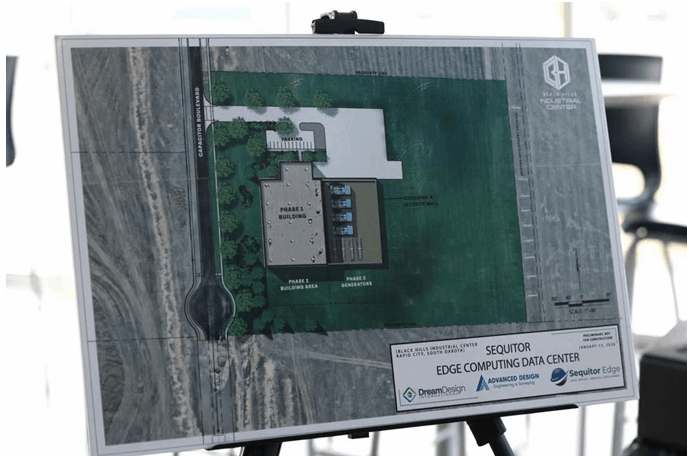
Sequitor Edge has announced plans to open a data center in Rapid City. The facility will be located in the Black Hills Industrial Center, located south of Old Folsom Road and east of Highway 79, just down the road from the Rapid City Landfill on the south side of the city.
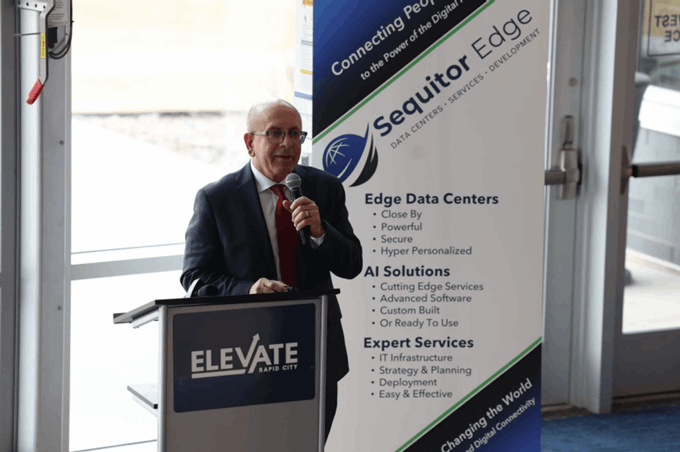
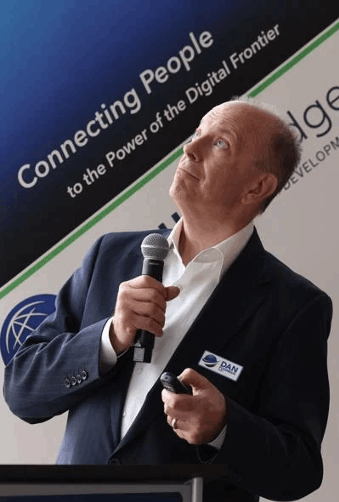
During an announcement ceremony on Wednesday, Feb. 11 at Elevate Rapid City, Dan Fuhrman, Sequitor Edge co-founder and CEO, said “we found something here, very special,” in Rapid City.
“A spirit of collaboration, a spirit of growth and economic development and partnership, which is exactly the profile of what excites us and what we’re looking for,” Fuhrman said.
Sequitor Edge plans to build a 30,000 square-foot building in the industrial park on a 10-acre plot. The facility will be modular, allowing for additions, company officials said during the announcement. The footprint will start out at about an acre.
The Black Hills Industrial Center is zoned properly for such a building and business. Sequitor Edge will still need to apply for building permits through the city.
Victoria Blatchford, vice president of business development for Sequitor Edge’s Great Plains operation, said the sides expect to close on the land around late March with hopes to break ground by late summer. It’s slated to take 14 months to complete once construction starts.
A data center is a facility that houses and runs large computer systems, powering websites, email, video streaming, and artificial intelligence applications, as well as cryptocurrency. There are more than 4,000 data centers nationwide, according to the National Conference of State Legislatures.
Sequitor Edge, based in Bennington, Nebraska, an Omaha suburb, said it plans to build 18 computing centers in the Upper Midwest and Great Plains in a total of 11 states. The company plans to build a center in Brookings as well.
The Rapid City facility will differ from other data centers because edge computing centers process and store data closer to where it is generated and used, increasing operational reliability for businesses, according to a release from Elevate Rapid City. Unlike hyperscale facilities that serve global networks, edge centers are intentionally localized — designed to work directly with companies in their communities, Elevate said.
Elevate noted it connected Sequitor Edge with Dream Design and other regional partners to assist with site selection and project coordination.
Blatchford said the facility will use 2 megawatts initially, with a maximum of 10 megawatts, noting its efficiency compared to other data centers is thanks in part to a Sequitor Edge proprietary design.
“Your moderate scale data centers might be only from maybe 25 megawatts up to 100. And then the big hyperscale is the 100 to the 500-ish (megawatts),” Blatchford explained.
The immense energy needs of AI and cryptocurrency are leading major tech companies to expand their data center capacity.
Per a report on data centers by the Congressional Research Service, U.S. data center’s annual energy use in 2023 (not accounting for cryptocurrency) was approximately 176 terawatt-hours, approximately 4.4% of U.S. annual electricity consumption that year, according to a report by Lawrence Berkeley National Laboratory. One terawatt is 1 million megawatts.
The service said some projections show that data center energy consumption could double or triple by 2028, accounting for up to 12% of U.S. electricity use.
Eric Wolff, business development manager for Black Hills Energy, likened the Sequitor Edge facility’s power usage to a grocery store or big box store.
“When people hear the term data center … their minds jump to hyper-scale campuses, very large, sitting on hundreds of acres, using large amounts of energy, maybe a lot of water,” Wolff said. “This project’s not that. This project’s been rightsized for Rapid City.”
Blatchford explained the facility will not consume water at the same rate as larger centers. Roughly half the power demand for data centers comes from the operation of electrical equipment, with the other half dedicated to cooling, the Congressional Research Service noted. A study by the International Energy Agency estimated a 100-megawatt U.S. data center would consume roughly the same amount of water as 2,600 households, accounting only for direct water consumption and averaged across the various cooling strategies, according to the service report.
Blatchford said the Rapid City center will only use around 20,000 gallons of water to fill its cooling pool. According to the Congressionally-founded Environment and Energy Institute, large data centers can consume up to 5 million gallons per day.
“It’s a closed-loop system,” she told the crowd of about 30 people who attended the event, explaining the water will be reused after the initial pool fill.
Blatchford told the Journal, “It’s very environmentally-friendly water and power usage” after the event.
Dakota Rural Action, a grassroots nonprofit, advocates for local voices in data center decisions. Black Hills native Lisa Tiger, a community organizer with the organization, told the Journal she was still familiarizing herself with the Sequitor Edge plan but spoke about the organization’s general approach to data centers.
“We’re not anti-data center. But we do have four strong pillars that we stand on … that decisions around these projects need to be locally driven. Local governments where these projects will be located need tools and support to evaluate proposals in a meaningful way. Public dollars must serve the public good. And transparency with these projects is non-negotiable. There are too many NDAs (nondisclosure agreements) on projects.”
Tiger expressed optimism about Sequitor Edge using a closed-loop system for water usage.
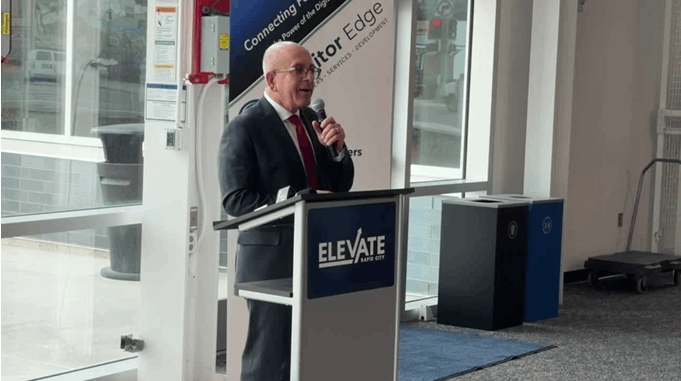
Black Hills Industrial Center developer Hani Shafai, president of Dream Design, said Sequitor “and the technology that they’re bringing to our community is a very critical component of infrastructure that will really take our community to the 21st Century.”
“The computer has transformed mankind’s way of life,” he said. “AI, and the technology that it is bringing, is going to be even a larger impact on the human life.”
The Sequitor Edge center is engineered to deliver secure, resilient, and high performance computing services to businesses across the region, Elevate said in its release. The facility will create three full-time, high-skilled positions with an average annual wage of $100,000.
The Rapid City facility’s clients will come from industries that depend on secure, fast, and reliable data processing, including advanced manufacturing, health care, defense-related industries, financial services, and other technology-enabled operations, Elevate said in the release.
“Anybody who has that immediate computational need of instantaneous information and reliability of the power end,” Blatchford said.
Blatchford highlighted the business will pay into the property tax coffers, plus charging sales tax on the services it provides to companies in the area. And the company hopes its presence means “other businesses will now have the opportunity to use the technology infrastructure that we can provide.”
She said the center will be able to provide services to communities within a 100-mile radius.
Photos from the Rapid City Data Center Announcement
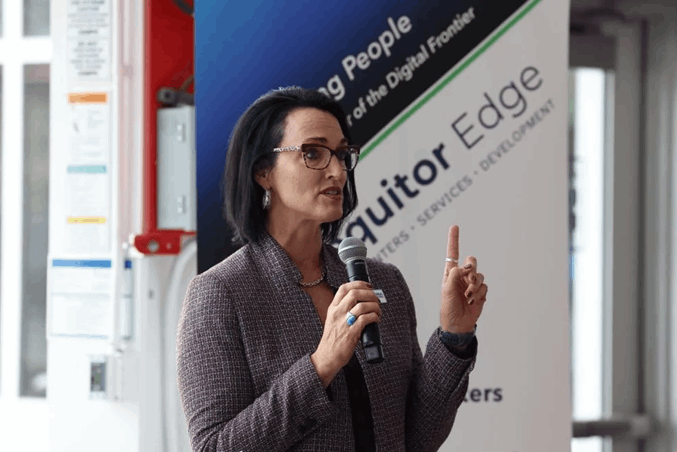
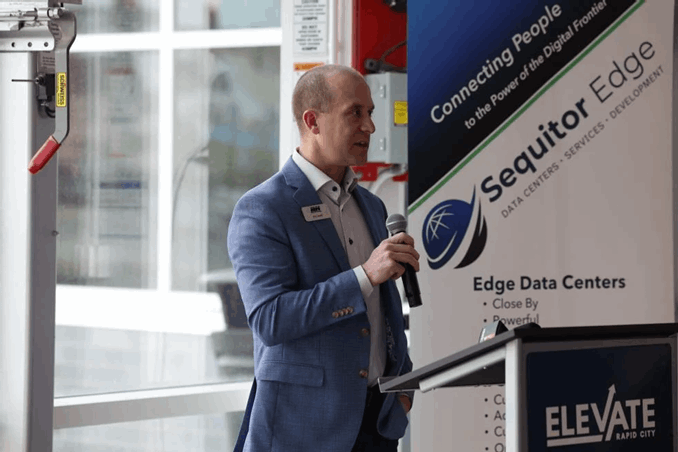
During an announcement ceremony on Wednesday, Feb. 11 at Elevate Rapid City, business community members revealed a data center in coming to the area. The Sequitor Edge facility will be located in the Black Hills Industrial Center, south of Old Folsom Road and east of Highway 79, just down the road from the Rapid City Landfill on the south side of the city.